Derzeit wird viel darüber geredet, dass ein Erreichen der Klimaziele nur mit einer massiven Reduktion des motorisierten Individualverkehrs erreichbar ist. Ein Umstellen auf Elektroautos verbessert die Situation nur marginal, da ein Großteil der CO2-Emissionen schon beim Bau erfolgt. Außerdem wünschen sich Menschen lebenswertere Städte – Städte die nicht nur als Verkehrsräume für ineffiziente Fahrzeuge dienen.
Es gibt ein Fahrzeug, das unseren Planeten retten könnte: Das Fahrrad. (Beinahe) Emissionsfrei, Platzsparend, effizient. Und es macht die Bevölkerung gesund – erstens da keine giftigen Emissionen anfallen und zweitens weil Leute die Radfahren ihre täglichen Bewegungseinheiten bekommen und dadurch gesünder und produktiver sind.
Was fehlt, damit mehr Leute auf das Fahrrad steigen? Infrastruktur, auf der man sich sicher fühlt und sicher ist; wie sie z.B. in den Infrastrukturrichtlinien der Radlobby Wien definiert werden. Kurz zusammengefasst: Entweder im Mischverkehr auf verkehrsberuhigten Straßen (max. 30 km/h, kaum Durchzugsverkehr) oder baulich getrennte Radwege. Mehrzweckstreifen, die Radfahrende in die Türzone von parkenden Autos und toten Winkel von LKWs drängen, sind keine Option. Außerdem sollten Radfahrende und Zu-Fuss-gehende getrennt werden um Konflikte zu vermeiden (wie z.B. am Ring). Parkplatzverlust darf keine Radwege verhindern dürfen!
Die Stadt Wien hat dazugelernt, die in den letzten Jahren entstandenen Radinfrastrukturen entsprechen oft diesen Richtlinien. Der Ausbau geht aber viel zu langsam, obwohl ein solches bereits 2003 ein Hauptradverkehrsnetz definiert wurde. Es wäre wichtig, endlich ein durchgehendes Radnetz zu schaffen. Mein Wunsch an die nächste Wien-Regierung (spätestens im Herbst 2020 wird ja wieder gewählt) wäre, dass dieses endlich umgesetzt wird.
Ein paar konkrete Forderungen dazu:
Lückenschluss Gürtelradweg zwischen Eichenstraße und Hauptbahnhof
Derzeit wird man hier durch Nebenstraßen geschickt – nicht attraktiv. Mein Wunsch wäre ein Zweirichtungsradweg auf der nördlichen Seite – damit die anwohnende Bevölkerung diesen gut nutzen kann.
Durchfahrten durch den ersten Bezirk
Es sind einige Einbahnöffnungen notwendig, z.B. Habsburgergasse; außerdem gehören die Routen besser angeschrieben
Lückenschluss Margaretenstraße
Nach der Einbahnöffnung heuer zwischen Spengergasse und Margeretenplatz fehlen nur noch wenige hundert Meter zum Gürtel. Angeblich ist eine Einbahnöffnung nicht geplant. Dabei würde hier eine super Radroute zwischen Zentrum und dem Herzen Meidlings entstehen, da die Arndtstraße bereits vollständig in beide Richtungen befahrbar ist. Die Infrastruktur zwischen Zentrum und Margaretenplatz gehört aber angepasst, da tw. Mehrzweckstreifen, tw. zu schmale Radwege die bereits jetzt am Kapazitätslimit sind.
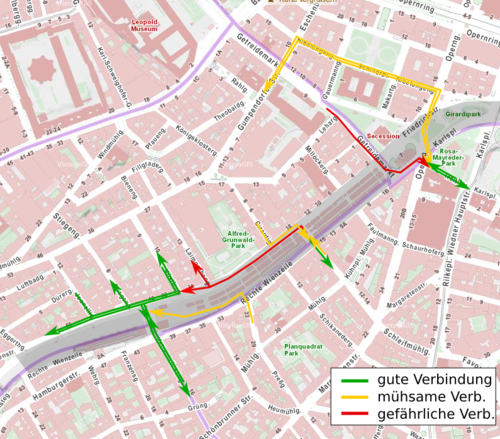
Verbindung Karlsplatz -> Getreidemarkt, Karlsplatz -> Linke Wienzeile
Vom Karlsplatz kommend sind die entsprechenden Radwege nur durch Umwege erreichbar. Ein Möglichkeit wäre ein Zweirichtungsradweg zwischen Treitlstraße und Getreidemarkt (bis Lehárgasse).
Karlsplatz: Radweg Rechte Wienzeile – Lothringerstraße Durch den Resselpark wird derzeit sehr viel Rad gefahren – eine Entlastung wäre eine Umwidmung einer der drei Fahrspuren um Radweg.
Ringradweg
Hier ist eine Trennung zwischen Zu-Fuss-Gehenden und Radverkehr notwendig. Z.B. könnte auf eine Kfz-Fahrspur reduziert werden und der gewonnene Platz für Radwege genutzt werden.
Dies ist nur eine kleine Auswahl an Maßnahmen. Ein gut ausgebautes, verbundenes Radnetz wird viel genutzt werden – das zeigen die Erfahrungen aus anderen Städten. Es entlastet den öffentlichen Verkehr, besonders zu den Stoßzeiten und kann damit beitragen zu einer Reduktion des motorisierten Individualverkehrs. Die Errichtung kostet natürlich Geld – ist aber im Vergleich zu Alternativen sehr kostengünstig. Straßen für Kfz und Ausbau des öffentlichen Verkehrs kostet ein Vielfaches!
Ich hoffe, dass sich in Wien zukünftig mehr bewegt.
Ich kann es ja immer noch fast nicht glauben, der Lückenschluss des Wientalradweges wird heuer gebaut. Fahrrad Wien hat heute den aktuellen Stand der Planung präsentiert. So ähnlich hatte ich das Ergebnis auch erwartet, mit Ladezonen, Verschwenkung beim Theater an der Wien, etc. Damit kann man sehr zufrieden sein.
Sehr spannend finde ich ja auch, dass heuer die Querung über den Gürtel zwischen Mollardgasse und Ullmannstraße gebaut werden soll. Damit entsteht eine Radroute Innenstadt – 6. Bezirk (Linke Wienzeile – Magdalenenstraße – Mollardgasse) – 15. Bezirk (Ullmannstraße via Sparkassaplatz) – Lobkowitzbrücke – 12. Bezirk (Meidling Hauptstraße) bzw. 14. Bezirk (Wientalradweg).
Ich sehe allerdings noch weiteren Verbesserungsbedarf:
Anschluss Oper: Ich war skeptisch, ob der Radweg tatsächlich bis zur Oper gebaut wird. Und tatsächlich, auf Höhe Café Museum muss man auf die Südostseite der Operngasse wechseln, was eine zusätzliche Ampelwartezeit verursacht.
Was noch mehr schmerzt: Der fehlende Anschluss an den Radweg Getreidemarkt nach Norden (wenn der kommen würde, wäre es sicher erwähnt worden) – Es wird weiterhin der Umweg durch die Nibelungengasse notwendig sein. Darum hatte ich schon vor Jahren dafür plädiert, den Getreidemarktradweg auf der westlichen Seite als Zweirichtungsradweg auszuführen. Die Stadtplanung wird sich nicht trauen, die Fahrbahn Getreidemarkt Richtung Norden auf eine Fahrspur zu reduzieren.
Weiteres Manko: wie befürchtet, fehlt die Verbindung vom Karlsplatz (Treitlstraße) zum neuen Radweg Linke Wienzeile. Der Radverkehr durch den Bärenmühldurchgang wird weiter zunehmen. So hätte man das bauen können (bzw. auch hier).
Was ich mir noch wünschen würde: Eine Einbahnöffnung der Girardigasse und der Lehárgasse. Dies würde eine wichtige Radroute zwischen 3., 4., 6. und 7. Bezirk ergeben (Schwarzenbergplatz – Gusshausstraße – Schleifmühlgasse – Linke Wienzeile – Girardigasse – Lehárgasse – Filigradergasse – Windmühlgasse – Mariahilfer Straße). Es ist nicht tragisch, wenn es jetzt nicht kommt, die aktuelle Planung verhindert eine solche Radroute nicht. (Auch eine alte Idee von mir)
Heute bin ich wieder mal durch die Cumberlandstraße (konkret zw. Einwanggasse und Beckmanngasse) spaziert – was ich sehr depremierend fand. Das könnte nämlich so ein schönes, lebenswertes Strasserl sein. Viele alte Häuser aber auch moderner Wohnbau. Kirche, Bahnhof, Kindergarten – nicht wahnsinnig viel Infrastruktur, aber zumindest ein bisschen. Und da entsteht ja vielleicht was mit dem umgebauten Siemensgelände? Geringer KFZ-Verkehr.
Der Zustand? Total desolat. Sehr schmale Gehsteige, die noch dazu ganz knapp um vorstehende Häuser herumgewunden sind. Total desolate Gehsteige! Von wegen Barrierefreiheit. Gehsteigparken. Keinerlei Aufenthaltsgelegenheiten.
Ich finde das schreit nach einer Machbarkeitsstudie, was man aus der Straße machen könnte. Zumindest mal ein paar Mock-Ups. Und vielleicht ein Straßenfest um zu demonstrieren, was man hier machen könnte.
Mehrere Aufenthaltsbereiche an Stellen wo ein bisschen mehr Platz ist mit ein bisschen Grün – vielleicht sogar Urban Gardening?
Ordentlich breite Gehsteige um Barrierefreiheit zu gewährleisten.
Durchgehend Radfahren gegen die Einbahn – das wäre vor allem auch für die AnwohnerInnen selber wichtig.
Man sollte auf jedenfall auch noch den Cumberlandstraßen-Teil bis zur Karlingergasse einbeziehen. Da wird ja auch neu gebaut und es gibt das Pfarrzentrum.
Hoffe Euch eine gute Anregungen gegeben zu haben Würde mich freuen davon zu hören, dass etwas daraus entsteht. Oder vielleicht gibt’s eh schon Pläne?
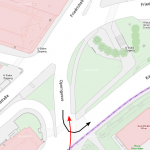
Prinzipiell finde ich es sehr gut, dass versucht wurde die Situation des Radwegs Operngasse am Karlsplatz zu verbessern. Leider muss man sagen, dass sich die Situation deutlich verschlechtert hat. Die Menge an Abbiegern von Operngasse -> Karlsplatz hat sich kaum verringert (obwohl dort ja jetzt das Abbiegeverbot herrscht), allerdings sind die Autofahrenden mehr gestresst (z.T. weil sie merken, dass sie gar nicht abbiegen dürfen, sich aber nicht zu helfen wissen; außerdem werden sie von den Geradeausfahrenden gestresst, weil sich diese behindert fühlen). Es scheinen viele Autofahrende einfach noch nicht bemerkt haben, dass sie jetzt anders fahren müssen.
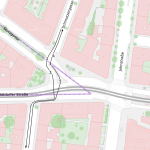
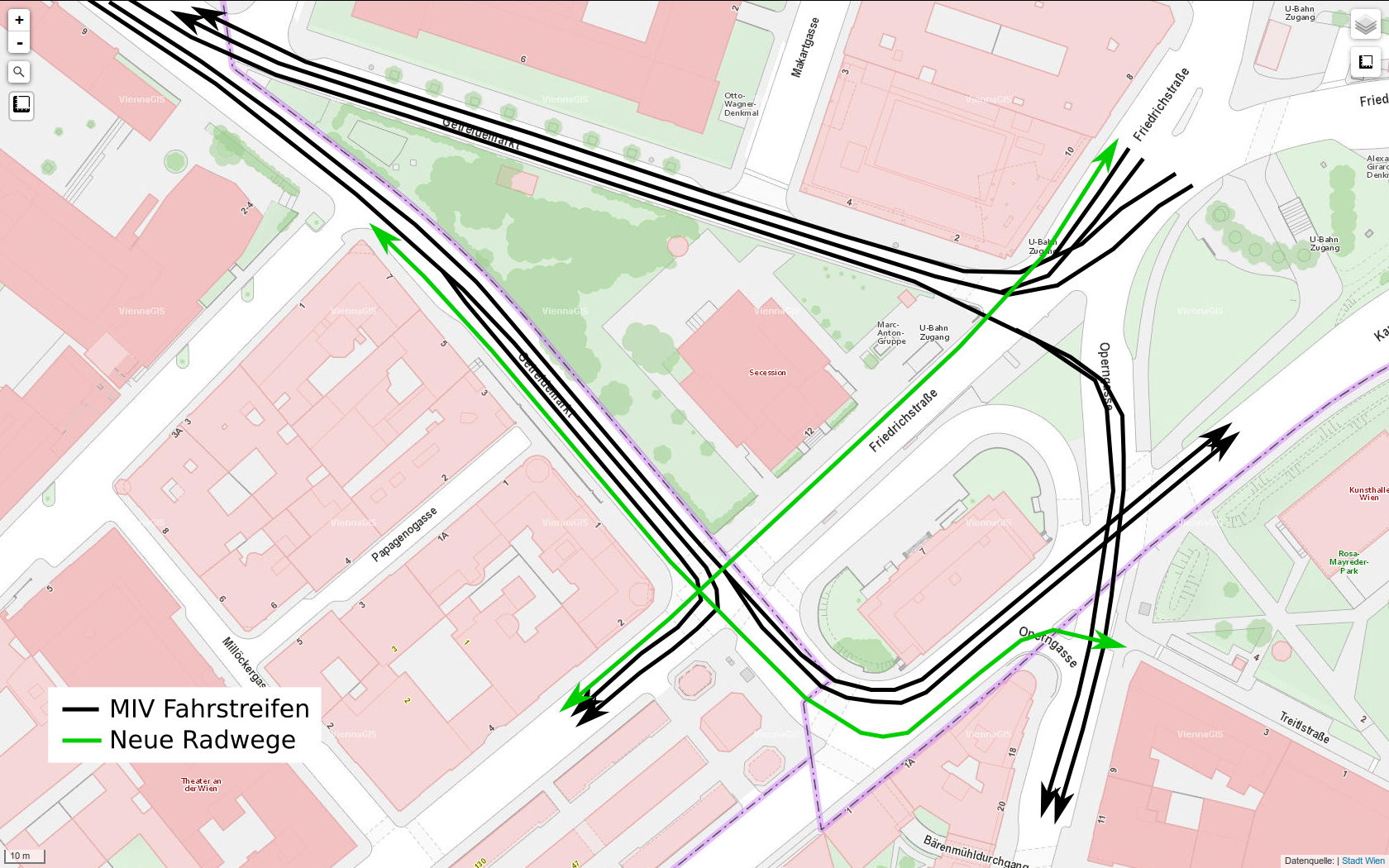
Konfliktstelle. Quelle: Stadtplan Wien 2016, Eigene Bearbeitung.
Mir sind verschiedene Möglichkeiten eingefallen die Situation zu verbessern. Ich hoffe, Sie greifen einige dieser Anregungen auf.
Radüberfahrt Rot markieren: Die alte Radüberfahrt war rot markiert, dies sollte unbedingt wieder gemacht werden. Derzeit sind die Radfahrenden sehr unsichtbar.
Wegweiser auf der Fahrbahn die zum Karlsplatz und/oder Schwarzenbergplatz weisen (so wie die Wegweiser vor der Oper Richtung Graz und Linz). Ev. zusätzlich Überkopf-Wegweiser Richtung Karlsplatz und/oder Schwarzenbergplatz.
Bewusstseinskampagnen über Zeitung und Infoscreens: Neue Wegführung am Karlsplatz.
Bauliche Maßnahmen um Abbiegen zu verhindern: Schranken oder Poller, die ein Abbiegen während der Grünphase verhindern. (Okay, dieser Vorschlag ist nicht ganz ernst gemeint).
Das Abbiegeverbot aufheben, stattdessen getrennte Ampelschaltungen für die Radüberfahrt und den Zebrastreifen sowie für den MIV. (Dieser Vorschlag ist ernst gemeint; meiner Ansicht nach der Einzige, der eine wirkliche Lösung für das Problem darstellt – es bräuchte halt die Wiedererrichtung der Abbiegespur).
Antwort vom 25. Juli 2016:
Sehr geehrter Herr Bösch-Plepelits!
Danke für Ihr Mail und Ihren Hinweis.
Die genannte Situation sollte sich mittlerweile nach dem Umbau eingespielt haben.
Seitens der zuständigen Magistratsabteilung 46 wurden betreffend Verkehrssicherheit alle notwendigen Maßnahmen gesetzt.
Ich hab wieder mal einen Radkummerkastenbeitrag erstellt:
Ich hab dies bereits in einem Mail an die Mobilitätsagentur bezüglich dem Radweg Getreidemarkt erwähnt, ich möchte jetzt noch einmal explizit darauf eingehen.
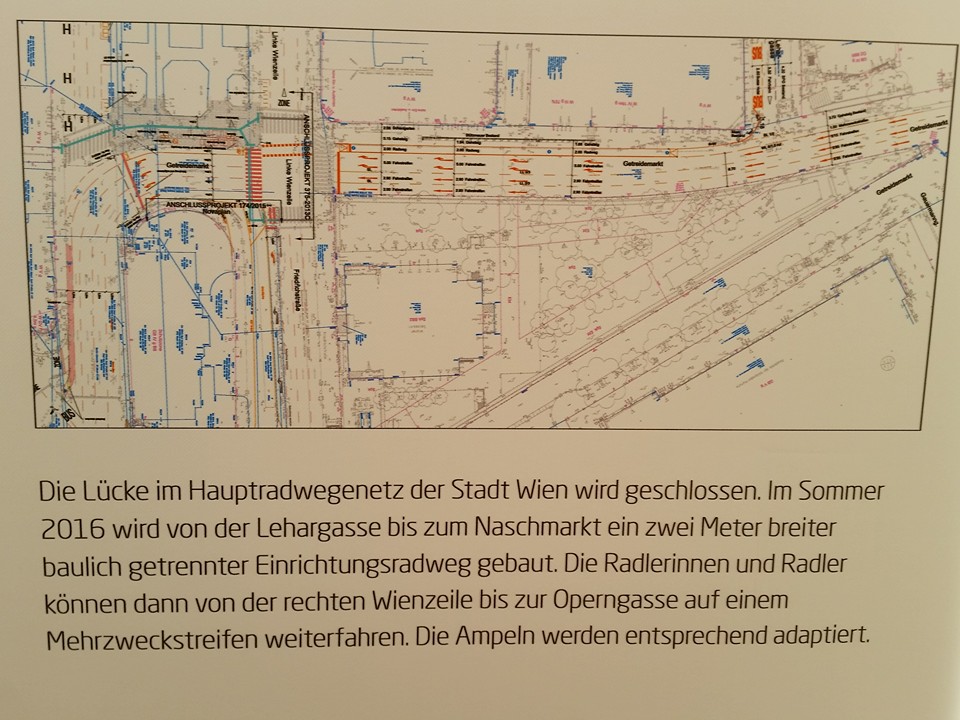
Ich sehe die Planung für die Kreuzungssituation Rechte Wienzeile – Operngasse – Treitlstraße als sehr kritisch. Wenn ich den Plan richtig interpretiere, soll ein Mehrzweckstreifen in der Rechten Wienzeile errichtet werden, der bis auf die Verkehrsinsel geführt wird mit folgender ampelgeregelter Radüberfahrt zur Treitlstraße.
Die Abbieger Rechte Wienzeile -> Operngasse werden aber diesen Mehrzweckstreifen kreuzen – ungeregelt! Ich verstehe nicht, wie man eine solche Planung machen kann, immerhin kommt es regelmäßig zu schweren bis tödlichen Unfällen zwischen rechtsabbiegenden LKW und Radfahrenden aufgrund der schlechten Sichtmöglichkeiten.
Ich weiss, dass die Bauarbeiten bald beginnen, aber ich bitte Sie diese Planung noch einmal zu überdenken.
Eine alternative Möglichkeit wäre:
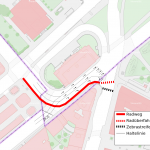
Einen (Zweirichtungs-)Radweg statt des ersten Fahrstreifens in der Rechten Wienzeile (dort sind immerhin insg. 4 Fahrstreifen) der mit einer ampelgeregelten Radüberfahrt (schräg) zur Treitlstraße geführt wird. Der zweite Fahrstreifen wird zu einer Rechtsabbiegespur in die Operngasse, der auch ampelgeregelt wird um Konflikte zu vermeiden. Bleiben immerhin noch zwei Geradeausspuren.
Sie finden diesen Plan im Anhang.
Der Radweg sollte dann gleich bis zum Naschmarkt geführt werden (Verbindung Karlsplatz -> Naschmarkt ist sehr wichtig, vor allem wenn dann auch der Wientalradweg in der Linken Wienzeile vervollständigt wird).
Weiters sollte auch ein Zebrastreifen errichtet werden. Vor allem TouristInnen haben oft Probleme vom Karlsplatz zum Naschmarkt zu finden und laufen dann an genau dieser Stelle über die Straße. Der Zebrastreifen kann gemeinsam mit der Radüberfahrt getaktet werden.
Der Bus in der Kreuzung Getreidemarkt / Rechte Wienzeile sollte Vorgrün bekommen, damit er sich problemlos in der ersten Geradeausspur einordnen kann.
Für den motorisierten Individualverkehr ist die Situation auch besser als derzeit, da die Kurve zum Abbiegen wesentlich großzügiger ist als derzeit.
Bitte überdenken Sie diese Situation noch einmal. Und wenn nicht, haben Sie schon eine Planung, wenn sich die aktuelle als Fehler herausstellt. Ich hoffe, dass es zumindest keine Todesopfer bis dahin gibt.
Stephan Bösch-Plepelits
Alternative Planung, Quelle: Stadtplan Wien 2016; Eigene Bearbeitung.
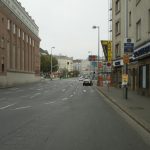
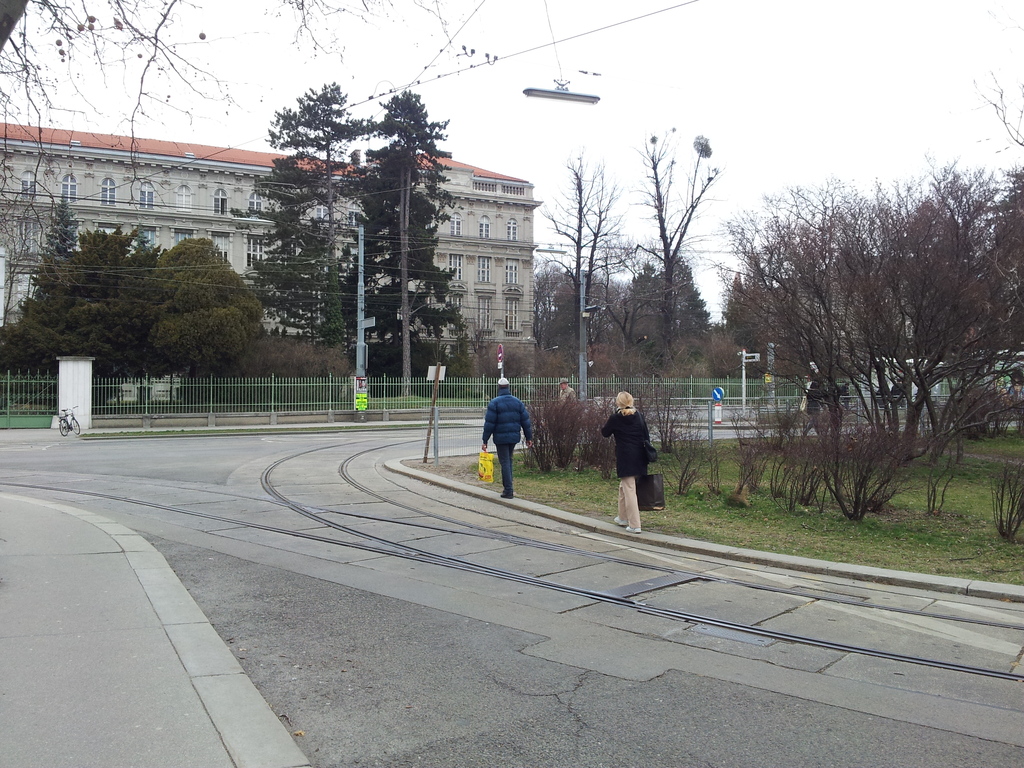
Ansicht Rechte Wienzeile vom Kreuzung Getreidemarkt. Quelle: Stephan Bösch-Plepelits, 2009.
Ansicht der Kreuzung Rechte Wienzeile / Operngasse von der Treitlstraße. Quelle: Stephan Bösch-Plepelits, 2009.
Antwort von der Mobilitätsagentur, 25. Juli 2016
Von der Mobilitätsagentur hab ich genau die gleiche Antwort bekommen, wie auf meine damalige Anfrage zum Getreidemarktradweg generell. Ich fühle mich ein wenig veräppelt.
Hier der Auszug der für die beschriebene Situation relevant ist:
Auch beim Angebot eines Radfahrstreifens wird der Radverkehr vom motorisieren Individualverkehr getrennt geführt. Sämtliche anderen Verkehrsteilnehmer dürfen diesen Streifen der Fahrbahn nicht befahren.
Als erste Maßnahme zwecks Netzschluss mit der Treitlstraße wird der Radfahrstreifen bis zur Insel in Höhe Rechte Wienzeile und Operngasse geführt und soll dort mittels Ampel die Fahrbahn der Operngasse queren. Mittelfristig soll das ungeregelte Rechtsabbiegen von der Rechten Wienzeile in die Operngasse unterbunden werden.
Nun, wir werden sehen, was passiert. Ich denke noch darüber nach, ob ich eine Antwort schreiben soll. Der Umbau ist inzwischen im vollen Gange, da ist wohl nichts mehr zu retten. Ich werde versuchen die (von mir erwarteten) Konflikte zu dokumentieren und dann nochmal zu kummerkasten.
Update, 4. August 2016
Inzwischen ist der neue Radweg bzw. Radfahrstreifen fertiggestellt und wird auch schon rege benutzt. Heute früh (ca. 9:15 und 9:30) hab ich mich für eine Viertelstunde hingestellt und hab ein bisschen mitgefilmt, wie sich die neue Situation so tut. Bis jetzt funktioniert es ganz gut, der MIV wartet recht ruhig auf die Radfahrenden. Nur eine brenzlige Situation gab es zwischen einem Motorrad und einem Radfahrer. Außerdem jede Menge TouristInnen (ich hatte nicht erwartet, dass die schon so früh so zahlreich sind). Macht Euch selber ein Bild, ich hab relevante Situationen zusammengeschnitten (knapp 3 Minuten). Die Größe der Verkehrsinsel ist – wie ich erwartet hatte – kein Problem, da sie für Radfahrende, die vom Getreidemarkt kommen, immer Grün ist.
Hier ein paar Snapshots aus dem Video:
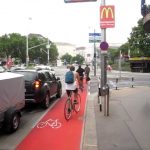
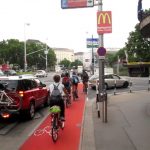
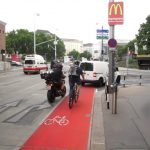
Brenzlige Situation zw. Motorradfahrer und Radfahrer.
Tourist mit Rollkoffer am Radfahrstreifen.
TouristInnen balancieren auf der Gehsteigkante.
Antwort an die Mobilitätsagentur, 4. August 2016
Sehr geehrte Frau Reichard!
Nun, inzwischen ist der Radfahrstreifen in der Rechten Wienzeile fertiggestellt. Wie ich bereits im originalen Radkummerkastenbeitrag schrieb, mache ich mir Sorgen, dass es hier zu schweren Unfällen kommen wird, da der Radfahrstreifen von den Abbiegern in die Operngasse gequert wird. Wie erwähnt, ist eine der großen Gefahren im Straßenverkehr der tote Winkel beim Rechtsabbiegen, der immer wieder zu tödlichen Unfällen führt.
Ich hab mir diese Situation heute in der Früh (4. August 2016, zw. 9:15 und 9:30) angesehen und ein wenig mitgefilmt. Ich habe diese ungefähr 15 Minuten auf knapp 3 Minuten zusammengekürzt und auf Youtube gestellt: https://www.youtube.com/watch?v=mTwRT6np-1U
Auf meinem Blog http://plepe.at/252 gibt es auch ein paar Snapshots aus dem Video zu sehen.
Wie Sie sehen können, kommt es immer wieder zu Konflikten. Es gab sogar eine brenzlige Situation zwischen einem Motorradfahrer und einem Radfahrer. Alles in Allem funktioniert die Situation derzeit recht gut, was sicher auch daran liegt, dass die Stelle neu ist und die Farbe noch sehr frisch. Außerdem ist Sommer. Im Herbst, wenn die Verkehrsdichten stärker sind, könnte es schon zu mehr Problemen kommen, vor allem wenn es Rückstau aus
der Operngasse gibt. Ich werde Anfang Oktober wieder ein Video machen.
Außerdem sind gut die Mengen an TouristInnen zu sehen, die über diese Verbindung zum Naschmarkt strömen (da hab ich ja in einem anderen Radkummerkastenbeitrag bereits darauf hingewiesen). Ein Tourist mit Rollkoffer ist doch tatsächlich den Radfahrstreifen entlang gegangen!
Mir ist klar, dass die Situation nun vorerst in Beton / Asphalt gegossen ist. Ich hoffe, dass es zu keinen schweren Unfällen kommen wird. Aber bitte teilen Sie der Politik und der MA46 mit, dass hier eine potentielle Unfallstelle gebaut wurde. Vielleicht kann ja nächstes Jahr dann ein Umbau erfolgen, der die Verkehrströme trennt, z.B. wie ich es im ursprünglichen Radkummerkastenbeitrag (und auch auf meinem Blog: http://plepe.at/252) beschrieben habe.
Eine weitere Problemstelle hat sich übrigens auch schon offenbart: Bei der Ausfahrt aus der Lehárgasse zum Getreidemarkt stehen immer wieder KFZ auf der Radüberfahrt. Hier wäre es wichtig die Durchfahrt von der Gumpendorfer Straße zu unterbinden (viele KFZ wollen sich die Ampel ersparen).
danke und grüße,
Stephan Bösch-Plepelits
Antwort von der MA46, 26. September 2016
Sehr geehrter Herr Bösch-Plepelits!
Bezugnehmend auf die E-Mail vom 4. August 2016, betreffend Gefahrenstelle Rechte Wienzeile – Operngasse, welche von der Mobilitätsagentur zur direkten Erledigung weitergeleitet wurde, teilt die Magistratsabteilung 46 hierzu Folgendes mit:
Die Maßnahme im Bereich der Operngasse – Rechte Wienzeile im Zusammenhang mit der Realisierung des Radweges am Getreidemarkt ist als Maßnahme zu werten, die einen direkten Netzschluss mit der Radfahrinfrastruktur in der Treitlstraße herstellen soll. Als nächster Schritt soll auch eine sichere Querungshilfe für den Fußgängerverkehr über die Operngasse angeboten werden. Dabei muss eine Änderung des Kreuzungsplateaus aus Sicht der Verkehrstechnik als auch aus dem Blickwinkel des Straßenbaus erfolgen. An dieser Lösung wird derzeit gearbeitet. Nach Realisierung dieser kniffligen Verkehrslösung wird sich die Verkehrssituation an dieser Örtlichkeit gänzlich ändern.
Die Magistratsabteilung 46 hofft auseichend informiert zu haben.
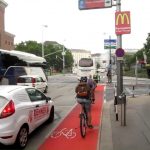
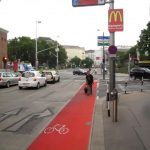
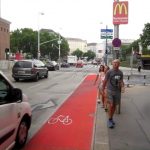
Im April 2016 hat die Radlobby Bezirksgruppe Wien15 eine Befahrung der Radroute Schönbrunn – Schmelz durchgeführt, dabei fanden wir bei der Kreuzung Schmutzergasse – Schanzstraße – Hütteldorfer Straße einige Probleme und hoffen, dass diese behebbar sind. Wir hatten auch Ideen für eine alternative Planung, die mit wenigen Maßnahmen umzusetzen ist und die Befahrbarkeit deutlich erhöhen kann.
Die Radroute Schönbrunn – Schmelz ist eine Basisroute des Wiener Hauptradverkehrsnetzes. Entsprechend gut sollte diese Route auch ausgebaut sein.
1. Wenn man aus der Schmutzergasse von Norden kommt, muss man sich auf der Schanzstraße auf der Fahrbahn einordnen. Dies ist nicht legal möglich, da man eine Sperrlinie zwischen den Fahrbahnen der Schanzstraße überfahren muss (siehe Abb. 2 und Abb. 3). Der Wegweiser nach Schönbrunn zeigt einfach nach links, nicht-ortskundige werden wohl – aufgrund der Sperrlinie – eher gegen den Einrichtungsradweg auf der Verkehrsinsel im Kreuzungsbereich fahren. Hier wäre eine zusätzliche Wegweisung für Radfahrende sinnvoll, zum Beispiel eine rote Fläche die vor bis zur Haltelinie zur Hütteldorfer Straße geht.
2. Bei Ampel-Rückstau in der Schanzstraße ist es oft unmöglich sich einzureihen und man muss auf dem schmalen Mittelstreifen stehen bleiben und warten. Wenn sich der Rückstau in der Grünphase zu bewegen beginnt ist es auch nicht leicht sich einzuordnen, immerhin muss man einen Fahrstreifen queren. Überhaupt ist die Fahrbahn sehr schmal, es gibt nur im vordersten Bereich vor der Haltelinie eine kleine Aufstellfläche für Radfahrende.
Außerdem kommt es immer wieder zu Konflikten mit PKW die von der Schanzstraße stadteinwärts kommend in die Schmutzergasse abbiegen oder in die stadtauswärts führende Fahrbahn umdrehen.
Für ungeübte Radfahrende ist diese Relation also nicht akzeptabel.
3. Der Einrichtungsradweg auf der Mittelinsel Richtung Norden endet derzeit mit einem Linksabbiegepfeil. Um in die Schmutzergasse zu fahren – was ja die Radroute ist – muss man aber gerade über die Fahrbahn fahren. Hier sollte also ein Geradeaus-Links-Pfeil aufgemalt werden. (siehe Abb. 3)
4. Dies wird erschwert durch die mangelhafte Wegweisung in diesem Bereich. Der einzige Wegweiser Richtung Schmelz befindet sich auf dem Einbahnschild im östlichen Bereich der Schmutzergasse und ist nur aus Richtung der Fahrbahn zu sehen. Es ist also für Radfahrende die aus Richtung Süden kommen unmöglich zu sehen (siehe Abb. 4). (Erschwerend kommt hinzu, dass das Einbahnschild ein bisschen verdreht zu sein scheint). Hier sollte auf jedenfall ein Wegweiser unter dem Radweg-Ende-Schild angebracht werden.
5. Die Grünphase der Querung Hütteldorferstraße ist gleichzeitig mit dem FußgängerInnenübergang über die Schanzstraße, Fahrbahn stadtauswärts. Radfahrende rechnen nicht damit, dass hier die FußgängerInnen kreuzen, daher kommt es immer wieder zu Konflikten.
Es sollte kein Problem sein, die Ampelphase für den MIV Hütteldorfer Straße – Schanzstraße zu verkürzen, da hier wesentlich weniger Verkehr ist als in der Hütteldorfer Straße selbst – die Grünphasen sind gemeinsam und daher exakt gleich lang.
Man könnte die derzeitige Grünphase der Fahrbahn Hütteldorfer Straße – Schanzstraße zweiteilen: Zuerst die FußgängerInnenquerung über diese Fahrbahn, damit FußgängerInnen die bereits warten mit einem Zug beide Zebrastreifen queren können. Danach könnte der MIV Grün bekommen bis zum Ende der jetzigen Grünphase, damit der MIV abfliessen kann und keinen Rückstau über die Kreuzung mit der Johnstraße verursacht.
6. Es wäre gut, wenn die Radüberfahrt ein paar Sekunden vor der Schanzstraße grün bekommen könnte, um Konflikte MIV – Radfahrende zu vermeiden.
7. Bessere Wegweisung. Auf die mangelnde Wegweisung hab ich schon bei Punkt 3. hingewiesen. Um ortsunkundige Radfahrende durch diese Kreuzung zu weisen sollten zumindest noch die folgenden Wegweiser angebracht werden:
Richtung Schönbrunn:
* Nach der Querung Hütteldorfer Straße ein Wegweiser nach rechts auf den Radweg.
* Bei der Kreuzung Hütteldorfer Straße # Schanzstraße nach links in die Sturzgasse.
Richtung Schmelz:
* Bei der Kreuzung Hütteldorfer Straße # Schanzstraße nach rechts auf den Radweg.
* Bei der Radüberfahrt über die Hütteldorfer Straße nach links auf die Radüberfahrt.
* Beim Ende des Einrichtungsradweges in der Schanzstraße unter dem Radweg Ende ein Wegweiser nach rechts in die Schmutzergasse (siehe Punkt 3).
8. Nachdem das Benützen der stadteinwärtigen Fahrbahn Schanzstraße nicht tauglich für ungeübte RadfahrerInnen ist (siehe Punkt 2), schlage ich folgende bauliche Änderung vor:
Den Einrichtungsradweg auf der Mittelinsel umzudrehen, sodass die Route hier jetzt südwärts verläuft. Die nordwärts fahrende Route könnte gleich nach dem FußgängerInnenübergang Schanzstraße stadtauswärts in die Schanzstraße eingeordnet werden, da ja der MIV hier während der Grünphase der Radüberfahrt über die Hütteldorfer Straße sowieso rot hat und daher keine Konflikte entstehen können. (siehe Abb. 4 und Abb. 5)
Zusätzlich sollte man den FußgängerInnenübergang zwischen den Fahrbahnen Schanzstraße etwas verschwenken, um eine Aufstellfläche für die Radfahrenden zu erhalten. Ein Zebrastreifen in der Konfliktzone RadfahrerInnen und FußgängerInnen ist sicher eine gute Idee.
Der einzige Nachteil dieser Lösung ist, dass es zu Konflikten zwischen abbiegenden PKW aus der Schanzstraße in die Hütteldorfer Straße stadteinwärts kommen kann (die gibt es derzeit auch schon für die nordwärts fahrenden RadfahrerInnen). Vorgrün für die Radüberfahrt würde diese Problematik reduzieren (siehe Punkt 5).
Zusammenfassung:
1. Südwärtsfahrend, muss eine Sperrlinie überfahren werden -> bessere Wegweisung
2. Südwärtsfahrend, Einordnen auf Schanzstraße nicht akzeptabel
3. Nordwärtsfahrend, Ausfahrpfeil aus Einrichtungsradweg korrigieren
4. Nordwärtsfahrend, Wegweiser in die Schmutzergasse fehlt
5. Nordwärtsfahrend, Konflikte mit FußgängerInnen auf Mittelinsel wegen gleichzeitiger Grünphase -> Ampelphase anpassen.
6. Nordwärtsfahrend, Vorgrün für Radüberfahrt.
7. Diverse fehlende Wegweiser.
8. Alternativplanung: Einrichtungsradweg umdrehen, Mitbenutzen der stadtauswärtigen Fahrbahn, Verschwenken FußgängerInnenübergang Schanzstraße.
Angehängt finden sie ein PDF mit folgenden Bildern:
1. Übersichtsplan der Radroute in diesem Bereich, wo die Problemstellen markiert sind.
2. Foto aus der Schmutzergasse auf die Schanzstraße in Richtung Hütteldorferstraße. Die Sperrlinie ist rechts vorne teilweise erkennbar. (siehe Punkt 1).
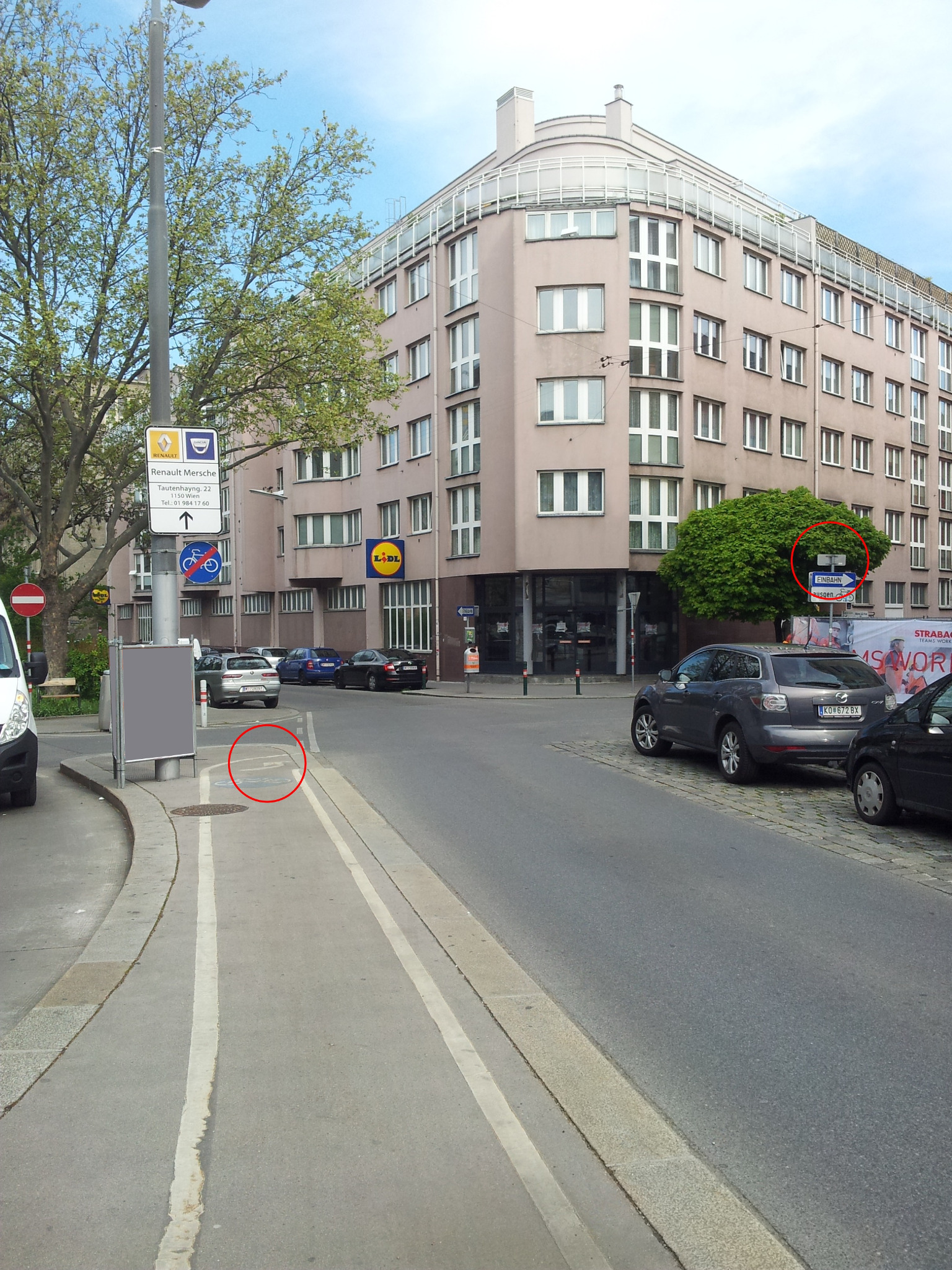
3. Foto vom Einrichtungsradweg in Richtung der Radroute. Der rote Kreis links markiert den Linksabbiegen-Pfeil auf die Schanzstraße (siehe Punkt 3). Der rote Kreis rechts markiert den Wegweiser Richtung Schmelz – der nur von der anderen Seite zu lesen ist (siehe Punkt 4).
4. Alternative Planung (siehe Punkt 8)
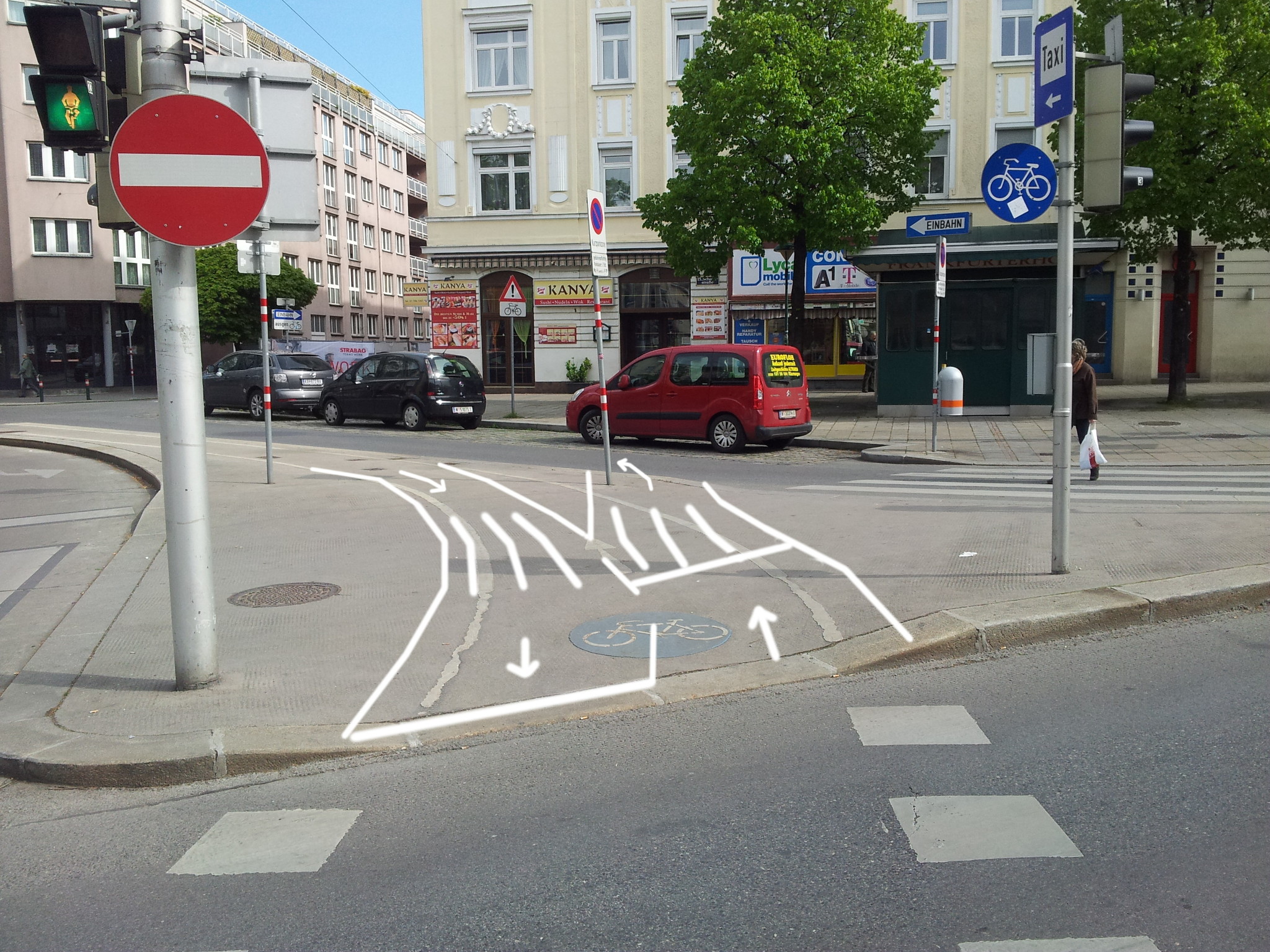
5. Visualisierung der umgestalteten Mittelinsel: von links hinten kommt der Einrichtungsradweg (der derzeit eben in die umgekehrte Richtung verläuft). Der Radfahrstreifen in die Schanzstraße verschwenkt nach dem Zebrastreifen auf die Fahrbahn. Der FußgängerInnenübergang ist etwas verschwenkt um Aufstellflächen in beide Richtungen zu erhalten, außerdem ein Zebrastreifen für den Konfliktbereich.
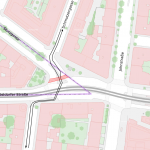
Abb. 1: Übersichtsplan der Radroute in diesem Bereich, wo die Problemstellen markiert sind.
Abb. 2: Foto aus der Schmutzergasse auf die Schanzstraße in Richtung Hütteldorferstraße. Die Sperrlinie ist rechts vorne teilweise erkennbar.
Abb. 3: Foto vom Einrichtungsradweg in Richtung der Radroute. Der rote Kreis links markiert den Linksabbiegen-Pfeil auf die Schanzstraße (siehe Punkt 3). Der rote Kreis rechts markiert den Wegweiser Richtung Schmelz – der nur von der anderen Seite zu lesen ist (siehe Punkt 4). Die Sperrlinie (siehe Punkt 1) ist hier auch sichtbar, oberhalb vom linken roten Kreis.
Abb. 4: Alternative Planung (siehe Punkt 8)
Abb. . 5: Visualisierung der umgestalteten Mittelinsel: von links hinten kommt der Einrichtungsradweg (der derzeit eben in die umgekehrte Richtung verläuft). Der Radfahrstreifen in die Schanzstraße verschwenkt nach dem Zebrastreifen auf die Fahrbahn. Der FußgängerInnenübergang ist etwas verschwenkt um Aufstellflächen in beide Richtungen zu erhalten, außerdem ein Zebrastreifen für den Konfliktbereich.
Der geplante Radweg/-streifen am Getreidemarkt hat großes Konfliktpotential. Warum nicht die Relation Getreidemarkt -> Operngasse über den östlichen Getreidemarkt führen und dafür einen ordentlichen Radweg zwischen Treitlstraße und Lehárgasse errichten?
Worum geht’s?
Letzte Woche wurde ja das Radbauprogramm 2016 vorgestellt und am ARGUS Bikefestival war sogar die Detailplanung für zwei der Maßnahmen ausgestellt (wieso werden die nicht im Internet veröffentlicht? – gottseidank hat ihn jemand abfotographiert): Lückenschluss Ring-Radweg beim Schottentor und der Plan für die Fortsetzung des Radstreifens Richtung Karlsplatz.
Ich hab am Bikefestival auch Herrn Blum zu diesen Planungen befragt – unter anderem die mir am meisten brennenden Frage, warum hier kein Zweirichtungsradweg kommt. Immerhin würde dies endlich die katastrophale Anbindung vom Karlsplatz in den 6. Bezirk (wo genau am Getreidemarkt viele TU-Institute und das TU-Audimax sind) beheben.
Ich hab erfahren, dass es Planungen für einen Einrichtungsradweg/-streifen am östlichen Getreidemarkt gibt mit einer Querung über den Getreidemarkt auf Höhe der Lehárgasse (oder erst auf Höhe der Einfahrt zur TU?). Ich hab dann leider nicht weitergefragt, wann dies denn umgesetzt werden soll, und warum nicht schon heuer. Außerdem wäre interessant, ob die Lehárgasse dann für das Radfahren gegen die Einbahn geöffnet wird und ob das bei den derzeitigen Umbauten bereits mitgeplant wurde.
Konfliktstellen
Ich hab über den Plan nachgedacht und diverse Konfliktstellen identifiziert:
Ausfahrt Lehárgasse: Hier wird der Radstreifen/-weg wahrscheinlich die meiste Zeit von wartenden PKWs blockiert werden (zumindest ist das derzeit so). Hier sollte entweder eine Sackgasse geschaffen werden oder eine Ampel oder zumindest auf andere Arten die Durchfahrt durch die Lehárgasse verhindert werden (die meisten PKWs wollen sich ja die Ampel Getreidemarkt/Gumpendorferstraße ersparen). Ev. Einbahn im Bereich Gumpendorferstraße – Millöckergasse umdrehen. Oder die gesamte Einbahn umdrehen, allerdings wären Abbieger aus dem Getreidemarkt auch nicht unproblematisch (von wegen toter Winkel).
Bereich Naschmarkt, rechte Wienzeile: Die Richtlinien und Vorschriften für das Straßenwesen (RVS) sehen bei der Dichte an Verkehr und den gefahrenen Geschwindigkeiten ausschließlich eine Trennung des Radverkehrs vor. Ein Radstreifen ist inakzeptabel.
Kreuzung rechte Wienzeile / Operngasse: Hier wird der Radstreifen über die Abbiegespur auf die Verkehrsinsel geführt mit einer Überfahrt zur Treitlstraße. D.h. PKWs müssen den Radstreifen beim Abbiegen kreuzen. Derzeit fahren die meisten RadfahrerInnen (also ich und die meisten die ich dabei beobachtet hab) am linken Rand der rechtesten Spur um zu verhindern geschnitten zu werden. Das ist dann wohl nicht mehr möglich. Ich prophezeie schwere Unfälle, weil hier der tote Winkel ein Problem ist.
Alternativen?
Ich hab lange über diese Probleme nachgedacht. Und mir ist eine Lösung eingefallen. Warum nicht den Abbieger Getreidemarkt -> rechte Wienzeile -> Operngasse zu streichen und durch eine Fahrspur auf der östlichen Seite des Getreidemarktes ersetzen, der dann direkt in die Operngasse mündet? Man müsste halt die Parkplätze auflassen und im untersten Bereich etwas vom Aufenthaltsbereich wegnehmen. Dann kann man die Geradeausspuren am Getreidemarkt auf einen (statt zwei) reduzieren und gewinnt Platz für einen Zweirichtungsradweg. Außerdem sollte bei der Querung über die Operngasse ein FußgängerInnen-Übergang errichtet werden, damit die TouristInnen nicht mehr verzweifelt den Weg zum Naschmarkt suchen müssen. Im Plan hab ich außerdem den fehlenden Naschmarktradweg eingezeichnet (dieser sollte ja bei aktuellen Planungen im Bereich immer mitgedacht werden – ewig wird sich die Stadt nicht dagegen wehren können).
Quelle: Stadt Wien, eigene Bearbeitung
Abbieger aus der rechten Wienzeile müssen halt eine Runde über die Friedrichstraße fahren (das können ja nicht so viele sein). Die zusätzliche Ampelphase bei der Kreuzung Friedrichstraße / Getreidemarkt Ost müsste für eine Radquerung auch kommen.
Vielleicht kommt ja doch noch eine zukunftsfähige Lösung am Getreidemarkt? Hab diesen Vorschlag übrigens an die Mobilitätsagentur geschickt. Bin gespannt auf Kommentare …
1. Reaktion, 22. April 2016
Sehr geehrter Herr Bösch-Plepelits!
Danke für Ihr Mail und Ihre Anfrage, die wir an die zuständige Magistratsabteilung 46 weitergeleitet haben.
Mit besten Grüßen Susanne Reichard
Mobilitätsagentur Wien GmbH Projekte und Kooperationen
2. Reaktion, 22. Juni 2016
Sehr geehrter Herr Bösch-Plepelits!
Nochmals Danke für Ihr Mail betreffend Radfahrstreifen am Getreidemarkt, das wir zur Stellungnahme an die zuständige Magistratsabteilung 46 weitergeleitet haben:
Die MA 46 teilt dazu folgendes mit:
Zur Frage warum kein Zweirichtungsradweg am Getreidemarkt zur Ausführung gelangen wird ist anzumerken, dass im Verlauf der ehemaligen Zweier-Linie Einrichtungsradwege angeboten werden.
Mit der Errichtung des Radweges wird noch keine Querungshilfe auf Höhe der Lehargasse über den Getreidemarkt angeboten. Erst wenn der Streckenabschnitt zwischen der Lehargasse und Mariahilfer Straße gebaut wird, soll eine Querung, die die Bezirke Mariahilf und Innere Stadt verbindet, angeboten werden.
Ob die Einbahnstraße Lehargasse für den Radverkehr in beiden Fahrtrichtungen geöffnet wird, muss noch geprüft werden.
Den Vorschlag die Einmündung der Lehargasse in den Getreidemarkt zu unterbinden, kann nicht näher getreten werden. Denn nach der Lehargasse befindet sich am Getreidemarkt jetzt eine Hotelvorfahrt für Busse. Diese Hotelvorfahrt wird nach dem Bau des Radweges in die Lehargasse verlegt. Solle dem Vorschlag näher getreten werden, könnte diese Vorfahrt nicht mehr angeboten werden. Auch eine Einbahnänderung würde die Verkehrssituation nicht verbessern, da dann sämtlicher Verkehr über die Gumpendorfer Straße abfließen müsste und somit neues zusätzliches Verkehrsaufkommen generiert wird.
Auch beim Angebot eines Radfahrstreifens wird der Radverkehr vom motorisieren Individualverkehr getrennt geführt. Sämtliche anderen Verkehrsteilnehmer dürfen diesen Streifen der Fahrbahn nicht befahren.
Als erste Maßnahme zwecks Netzschluss mit der Treitlstraße wird der Radfahrstreifen bis zur Insel in Höhe Rechte Wienzeile und Operngasse geführt und soll dort mittels Ampel die Fahrbahn der Operngasse queren. Mittelfristig soll das ungeregelte Rechtsabbiegen von der Rechten Wienzeile in die Operngasse unterbunden werden.
Das Auflassen eines Fahrstreifens am Getreidemarkt ist eine sehr ambitionierte Maßnahme, denn in Richtung Karlsplatz fahren täglich durchschnittlich 23.000 Kraftfahrzeuge. Eine Reduktion um einen weiteren Fahrstreifen hätte massive negative Auswirkungen auf das angrenzende sekundäre Straßennetz.
Auch für den Bereich des Nachmarktes zwischen dem Getreidemarkt und der Köstlergasse wurden Planungen für die Schaffung einer Radfahranlage durchgeführt. Der notwendige Planungsprozess für eine Umsetzung dieser Radfahrinfrastruktur ist noch nicht abgeschlossen.
Mit besten Grüßen
Susanne Reichard
Mobilitätsagentur Wien GmbH
Projekte und Kooperationen
Ich hatte große Hoffnungen (leider eh keine Erwartungen) für den zukünftigen Radverkehr in Wien. Insofern bin ich vom aktuellen Radwegebauprogramm 2016 sehr enttäuscht. Die einzigen Highlights sind die Goldschlagstraße im 15. Bezirk und die Entflechtung des Wientalradweges bei der Längenfeldgasse.
Getreidemarkt
Besonders enttäuscht bin ich vom angekündigten Radweg am Getreidemarkt. Soweit ich das verstehe, wird der als Einrichtungsradweg ausgeführt, ohne Änderung der Fahrspuren. Es wäre so wichtig, dass endlich eine Verbindung vom Karlsplatz zur Lehargasse geschaffen wird, da dort ein Standort der TU-Wien mit vielen Instituten und dem TU Audimax ist, d.h. diese Route nehmen mehrere tausend Studierende täglich (hauptsächlich zu fuss). Wenn hier nur ein Einrichtungsradweg errichtet wird, ist weiterhin ein Umweg über Nibelungengasse – Eschenbachgasse (700m vs. 300m) notwendig.
Meines Erachtens ist die einzig logische Variante ein Zweirichtungsradweg zwischen Lehargasse (besser Museumsquartier) – Getreidemarkt – Rechte Wienzeile zur Treitlstraße auf der westlichen Seite, so wie es auch das Institut für Verkehrswissenschaften in ihrem Diskussionspapier vorschlägt. Die Lehargasse sollte dann für das Radfahren gegen die Einbahn geöffnet werden.
Ein Einrichtungsradweg (oder Mehrzweckstreifen) am Getreidemarkt auf der östlichen Seite löst das Problem nicht, er würde nur zusätzliche Ampelwartezeiten schaffen. Eine Querung bei der Lehargasse wird wohl nicht möglich sein.
Zukunft?
Im STEP 2025 wurde als Zielvorgabe für den Radverkehrsanteil im Modal Split 20% angenommen, bei derzeit etwa 7%. Die Radinfrastruktur in Wien steht damit vor großen Herausforderungen. Es gibt in Wien kaum Radrouten die nicht größere Mängel aufweisen, z.B. Lange Ampelwartezeiten (z.B. Gürtelradweg), Konfliktstellen mit dem FußgängerInnenverkehr (z.B. Ringradweg), Schmale Einrichtungsradwege auf denen Überholen schwierig ist (Museumsstraße, Praterstraße).
Meines Erachtens gibt es aber zwei Maßnahmen die besonders wichtig wären um den Radverkehr in der Stadt weiterzubringen, und hier darf einfach nicht noch eine Legislaturperiode ohne Lösung vergehen (2017 geht wohl noch, aber 2018 ist wieder beginnender Wahlkampf):
Verbindung Hauptroute West ins Zentrum
Der Wientalradweg wird derzeit gerade zu einer Rad-Langstrecke ausgebaut. Das ist gut und richtig, es fehlt aber das große Problem des Wientalradweges: die Verbindung zum Zentrum. Im Plan zur Langstrecke findet sich immerhin eine solche Markierung.
Derzeit endet der Radweg bei der Köstlergasse und man muss entweder auf den Getreidemarkt (Umweg zur Oper: 300m, viel zu viel MIV – motorisierter Individualverkehr) oder über die Kettenbrückengasse – Margaretenstraße – Operngasse (Umweg zur Oper: 500m) ausweichen.
Die logische Maßnahme wäre den bestehenden Zweirichtungs-Radweg in der linken Wienzeile bis zur Oper zu verlängern.
Südgürtel
Da wurde über Jahre der Hauptbahnhof am Südtirolerplatz neu gebaut, was aber noch immer fehlt ist die Anbindung über den Gürtel mit dem Rad nach Westen. Der derzeit bestehende Gürtelradweg endet in einem Parkplatz ein gutes Stück westlich vom Matzleinsdorferplatz.
Im Hauptradwegenetz ist zwar eine Verbindung über Grünwaldgasse – Wiedner Hauptstraße – Gassergasse und Schelleingasse ausgewiesen, diese erlaubt aber kein schnelles Weiterkommen.
Hier sollte dringend eine Verbindung direkt am Gürtel errichtet werden, am besten in der Nebenfahrbahn auf Seite des 4. und 5. Bezirkes. Wichtig ist, dass diese in beide Richtungen beradelbar ist.
Fazit
Ich denke, wenn es die Stadtregierung schafft, diese zwei Maßnahmen in dieser Regierungsperiode umzusetzen, dann ist ein Meilenstein im Radverkehr gesetzt und es ist möglich den Modal Split im Radverkehr entsprechend der Zielvorgaben zu erhöhen – und vielleicht sogar zu übertrumpfen. Wenn dies nicht möglich ist, dann ist das vor allem ein Armutszeugnis für eine grüne Regierungsbeteiligung in Wien.
Vielen Dank für Ihre E-Mail vom 01. April 2016 an Frau Vizebürgermeisterin und amtsführende Stadträtin Mag.a Maria Vassilakou.
Die Stadt Wien hat am 01. Jänner 2013 die Mobilitätsagentur gegründet, um den Kontakt mit den BürgerInnen Wiens zu verbessern und ihre Wünsche und Anliegen schneller und effizienter bearbeiten zu können. Wir haben Ihr Schreiben deshalb an die Mobilitätsagentur weitergeleitet und diese wird sich so rasch wie möglich Ihrem Anliegen annehmen.
Mit freundlichen Grüßen
Claudia Smolik
Büroleiterin
Büro Vizebürgermeisterin und amtsführende Stadträtin Mag.aVassilakou
Geschäftsgruppe Stadtentwicklung, Verkehr, Klimaschutz, Energieplanung und BürgerInnenbeteiligung
Anmerkung
Über diese Weiterleitung bin ich nicht besonders glücklich. Für mich ist jetzt die Politik gefordert und ich hab jetzt das Gefühl, dass ich nur eine „beamtete“ Antwort zurückbekomme. Aber lassen wir uns überraschen …
2. Reaktion, Mail am 22. April 2016
Sehr geehrter Herr Bösch-Plepelits!
Danke für Ihr Mail, das vom Büro von Frau Vizebürgermeisterin Maria Vassilakou an uns weitergeleitet wurde.
Danke vor allem auch für Ihr Feedback zur Radverkehrsplanung in Wien und dem aktuellen Bauprogramm.
Das Miteinander und die Bedürfnisse aller Verkehrsteilnehmer bei der Planung und der Sicherstellung der Verkehrssicherheit zu berücksichtigen, ist eine große Herausforderung, die in der Praxis leider oft Kompromisse verlangt. Dabei nimmt natürlich der Radverkehr eine wichtige Stellung ein, denn Ziel der Stadt Wien ist es ja, den Radverkehrsanteil deutlich zu erhöhen. Das Wiener Radverkehrsnetz wird daher laufend erweitert, wobei natürlich die Verbesserung der Verkehrssicherheit und Lückenschlüsse eine große Rolle spielen.
Zu den einzelnen erwähnten Punkten können wir Ihnen nach Rücksprache wie folgt mitteilen:
Ad Getreidemarkt:
Ein Mail von Ihnen dazu ist ja ebenfalls bei uns in der Mobilitätsagentur eingelangt. Dieses wurde – wie Ihnen mitgeteilt – zur Prüfung an die zuständige Magistratsabteilung 46 weitergeleitet. Wir halten Sie gerne am Laufenden.
Ad Langstrecke West/Linke Wienzeile/Naschmarkt:
Derzeit sind Überlegungen für einen Radweg-Netzschluss im Bereich Wienzeile/Naschmarkt in Prüfung. Die konkreten Detailplanungen dazu sind aber noch nicht abgeschlossen.
Südgürtel:
Zum genannten Bereich gibt es eine Machbarkeitsstudie der Magistratsabteilung 18. Details dazu liegen derzeit allerdings noch nicht vor, da die diesbezüglichen politischen Entscheidungen noch offen sind.
Ich hab ja in meinem letzten Post meine Arbeit aus der Übung Verkehrsplanung veröffentlicht, was auf ganz schönes Medienecho gestoßen ist. Die Radlobbys IG-Fahrrad und Argus haben meinen Vorschlag auf ihren Homepages veröffentlicht, worauf es auch auf derStandard.at diskutiert wurde.
Nachdem die Diskussion zum Radweg wohl noch länger nicht abgeschlossen ist, möchte ich noch die folgende Arbeit einbringen, die ich heute vormittag erstellt hab – eine Sammlung der derzeitigen Fuß- und Radverbindungen zwischen 4. und 6. Bezirk.
Ich hoffe, die Diskussion damit etwas bereichern zu können. Es würde mich freuen wenn einige der Verbesserungsvorschläge – die ich am Ende der Arbeit bringe – umgesetzt würden (ich wäre vermutlich täglicher Nutzer davon).
Im Studium Raumplanung lernen wir, dass man fehlende Wegverbindungen an den Trampelpfaden auf Grünflächen erkennt. Ein solcher findet sich in Breitensee zwischen dem westlichen Ende der Stra?enbahnstation der Linie 49 und dem Abgang zur S-Bahn-Station (im Plan braun eingezeichnet).
Nun, mit einem solchen Trampelpfad fallen mir spontan drei Dinge ein, die man damit machen kann:
den Weg offiziell machen (z.B. in dem man ihn asphaltiert und damit barriererfreier gestaltet) – super
den Trampelpfad so lassen wie er ist – ok
eine Barriere einbauen, damit der schöne Rasen nicht weiter zertrampelt wird – mies
Entschieden hat man sich für die dritte Option. Es wurde ein Zaun aufgestellt (siehe Bild 1; im Plan schwarze Linie) der eine Benützung des Pfades verhindert. Die Alternative ist, dass man den Randstein entlangbalanciert (siehe Bild 2; roter Weg) oder den Umweg über das östliche Ende des Parks in Kauf nimmt (blauer Weg).